Draft an affidavit for family court, one sworn fact at a time
Build your sworn statement from the Declaration and Verification templates: numbered paragraphs, exhibit references, and a signature section with an optional notary block. Every fact is a [placeholder] that you write and check yourself.
Optional notary section in the Verification template
Exhibits numbered, each with a SHA-256 fingerprint
Organizing software, not a law firm
1of 4
Affidavit or declaration: your court decides which
Both are written statements of facts that you swear or affirm are true. An affidavit is usually signed in front of a notary or another official; a declaration is usually signed under penalty of perjury without one. Which your court accepts, and when, depends on its rules, so check the court's forms page or ask the clerk's office before you start.
The Your court page gathers links to your court's official rules, forms and self-help pages
Saved copies of those pages show the date each one was retrieved
The Verification template asks you to keep the signing form your court accepts: penalty of perjury, or an oath before a notary
Its notary section is optional; keep it only if your court requires a notarized statement
2of 4
Numbered facts, in your words, with a [placeholder] for each
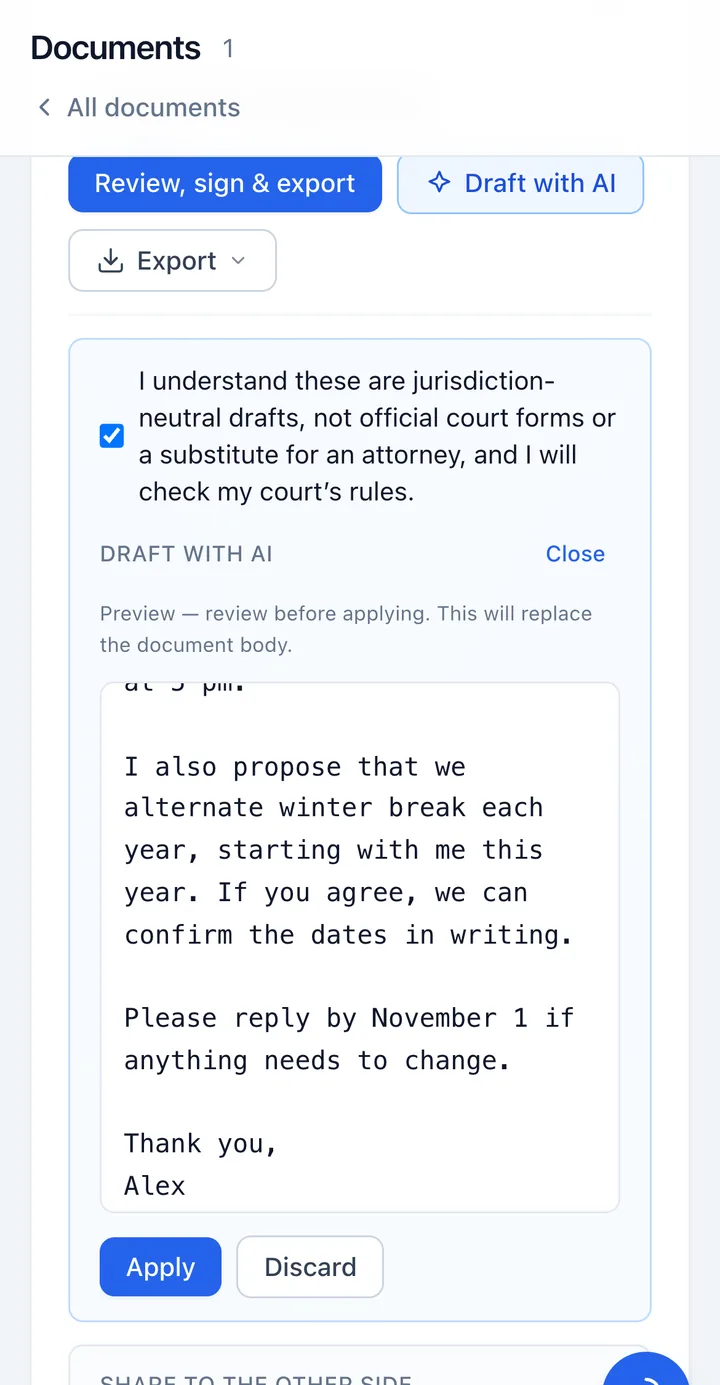
An affidavit is easier for a judge to follow when every paragraph holds one fact with its date. Start from the Declaration template: it opens with your role in the case and that you write from personal knowledge, then gives you numbered paragraphs to fill. Change the title and the closing wording to match the form your court accepts.
AI drafting uses AI actions. The free plan includes 6 to try it.
In the app
Caption, court and case number merged from your case
Numbered paragraphs you add, remove or reorder
[Placeholders] for every fact, date and name
AI drafting can build a first version from your own timeline and evidence, leaving the gaps open
3of 4
Attachments numbered the same way everywhere
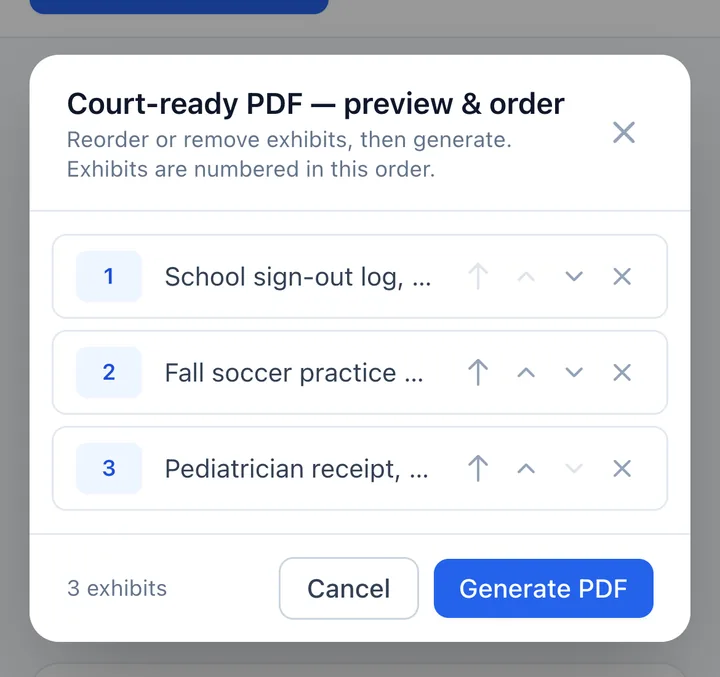
Many affidavits point to attached documents: a text thread, a school record, a receipt. Give each one a single number, cite it in the paragraph it supports, and attach them in that order. The app numbers your evidence and builds one exhibit PDF, so the numbers in your affidavit and in your attachments match.
The next free exhibit number for each item, in date order
Reorder or leave out exhibits in a preview before generating
A cover and index page, with a SHA-256 fingerprint listed for each file
Read it, confirm it, then sign the way your court requires
Sign an affidavit only after every [placeholder] is filled in or deleted and every statement is true to your knowledge. If your court requires a notary, wait to sign until you're in front of one. The app asks you to confirm you prepared and reviewed the document before export, and nobody at Custody Commander reviews it.
Create your account, then after a short setup you can try Full Suite free for 7 days. Card required; then $24.99/mo or $299/yr (about 82¢ a day) until you cancel. Cancel before day 7 and you pay nothing. Or subscribe now — $299/yr
50% off · 20× the AI
Full Suite Max
Everything in Full Suite, with 20× the AI actions.
$99.99$49.99/mo
or $899/yr$399/yr
Everything in Full Suite: all five tools and the assistant
6,000 AI actions a month (20× Full Suite)
50% off (normally $99.99/mo), locked in as long as you don’t cancel
Already on Full Suite? Get 20× the AI credits for only +$25/mo more (prorated in place)
Clean, printable exports + free attorney & advocate access (on every plan)
$49.99 a month, renews until you cancel. Cancel online in two clicks.
Hearing Pass · one-time
$49 once for 30 days of hearing prep. Nothing renews.
Everything in Full Suite for 30 days from the day you buy it: all five tools, the assistant, AI included, and exports without a watermark. No subscription and nothing to cancel. When the 30 days end you’re back on the free plan, and nothing you added is deleted.
Your case stays private to your account until you invite someone and choose what they see. Data is encrypted in transit and at rest, and we don’t sell your personal information.
Your files stay yours
Originals are kept unchanged. Download your complete Case Bundle, every original file plus a manifest, free on any plan, before or after you cancel.
Cancel anytime, in two clicks
The free plan has nothing to cancel. Paid plans renew until you cancel online in two clicks, and the Hearing Pass never renews.
Organizing software, not a law firm
It organizes the files, dates and messages you provide. It doesn’t give legal advice, choose what you file or predict what a court will do.
Questions, answered straight
Frequently asked questions
What is an affidavit for family court?
It's a written statement of facts that you swear or affirm is true, usually signed in front of a notary or another official. Family courts use affidavits and declarations for many purposes, and each court sets its own rules on format and signing. Check your court's forms page or self-help center for yours.
Is an affidavit the same as a declaration?
They're similar: both are sworn written statements of facts. The main difference is usually how they're signed, with an affidavit sworn before a notary and a declaration signed under penalty of perjury. Your court decides which it accepts and when, so check its rules.
Does Custody Commander have an affidavit template?
There's no template named Affidavit. The Declaration template gives you numbered paragraphs and a penalty-of-perjury signature block, and the Verification template lets you keep the oath-before-a-notary form with an optional notary section. You can use them to lay out a sworn statement; neither is an official court form, so your court's own form comes first if it has one.
Do I need a notary?
It depends on your court and on the document. Some courts accept a statement signed under penalty of perjury; others require a notarized affidavit. Ask the clerk's office or self-help center, or a licensed attorney where you live.
Can the app write my affidavit for me?
AI drafting can turn facts already in your case into numbered paragraphs, leaving [placeholders] for anything it doesn't have. It doesn't choose which facts to include or what to ask for, and nobody at Custody Commander reviews the result. You read, edit and confirm every statement before you export.
Is it free?
Yes. The free plan needs no card and never expires; it includes the document templates, up to 10 evidence items and 6 AI actions, and its exports carry a DRAFT mark. Full Suite ($24.99 a month or $299 a year) exports clean and includes 300 AI actions a month. A one-time $49 Hearing Pass gives 30 days of everything and never renews.
Can I draft documents in every state?
In most states the app drafts jurisdiction-neutral documents from templates, with [placeholders] for your court's details, and they aren't official court forms. In a few states, drafting stays off until that state's review is finished; the app says so when you start a draft. Organizing evidence, the timeline and exports work in every state.
Is this legal advice?
No. Custody Commander is organizing software, not a law firm. It helps you lay out your own facts; it doesn't tell you what to say, what to ask for or how a court will view it. For advice, talk to a licensed attorney where you live, or ask your court's self-help center about free help.
Start your family court affidavit
Lay out your facts in numbered paragraphs, cite your exhibits and sign the way your court requires. Free plan, no card needed.