Represent yourself in family court with one organized case file
People represent themselves in family court for many reasons. Custody Commander keeps the whole case in one place: a step plan for what's still missing, numbered evidence, a dated timeline, a tabbed binder and private notes for the hearing.
A self-represented case has many moving parts: papers, dates, deadlines and the court's own forms. To represent yourself in family court with less guesswork, start by listing what you already have and what you still need. After you sign up, a short setup chat asks about your case and turns your answers into preparation steps you can check off.
A setup chat that asks about your case and builds a preparation plan
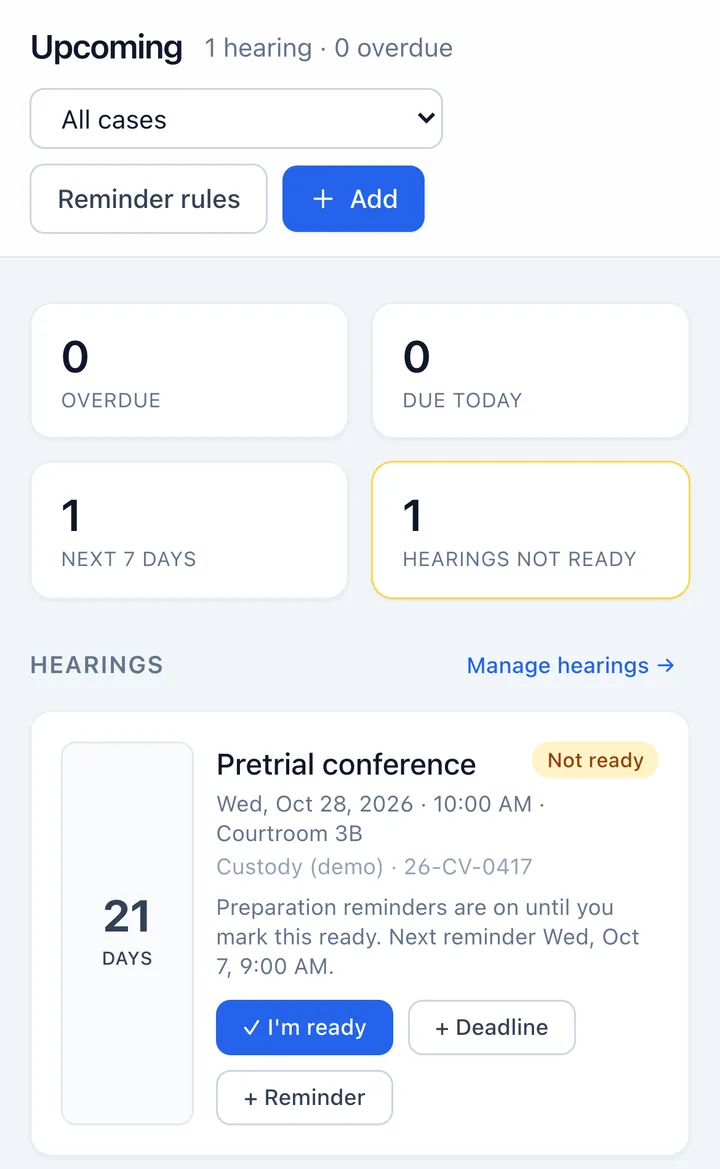
A What's missing list that keeps the open steps in view
Links to your court's official rules, forms and self-help pages, each with the date it was retrieved
Every related court case number in the same case file, each with its own deadlines and documents
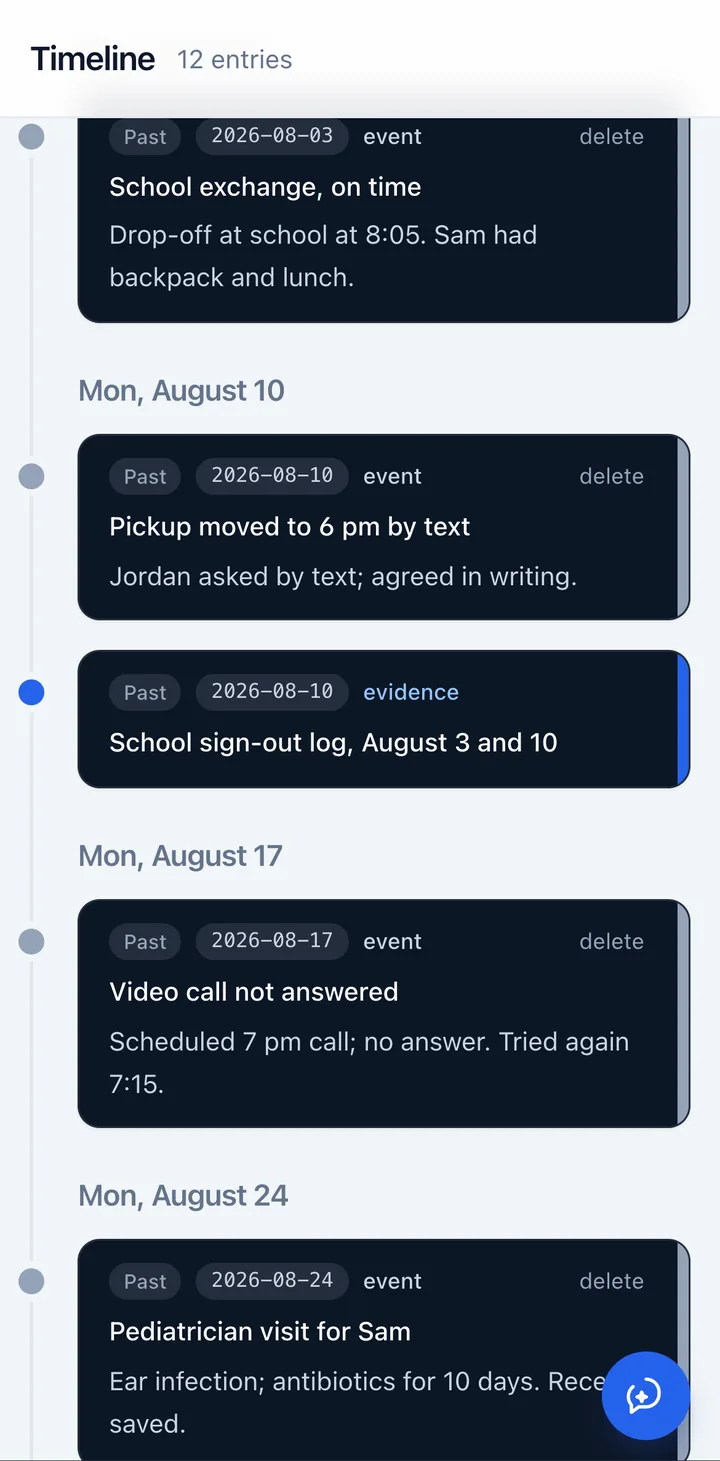
Every date and event on one timeline you can print
A short, dated timeline helps anyone reading your papers follow events in order. Keep each line to facts: the date, what happened and which record shows it. In the app, events, dated files, key dates and hearings land on one master timeline that sorts itself, so you aren't rebuilding the order by hand before each hearing.
Tell the assistant what happened in plain English and it adds the dated entry (uses AI actions)
Dated evidence lands on the timeline next to your own entries
Entries grouped by month; search, and filter by case, type, year or month
Export the timeline to PDF or Word (free-plan exports carry a DRAFT mark)
Numbered exhibits in a binder, plus a private copy for you
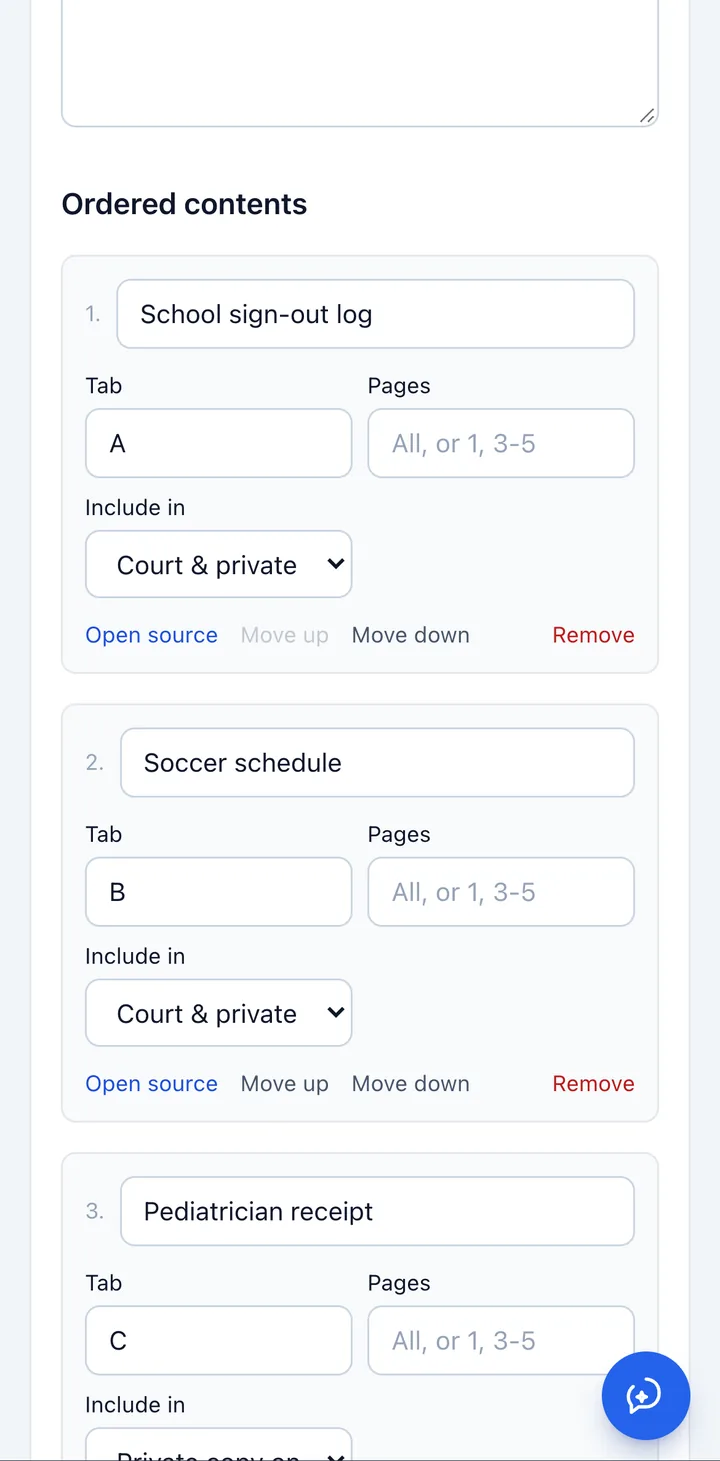
When you present your own case, you also organize your own exhibits. A binder with a contents page, tab dividers and page numbers lets everyone turn to the same page at the same time. Build the court copy and your private working copy from the same binder, so the two always match.
Add screenshots, photos, PDFs and documents, up to 25 MB per file, with each original kept unchanged and fingerprinted (SHA-256)
Exhibits numbered in the order you set, or type the label your court uses and it's kept as-is
Tabs, a contents page with page ranges, and page numbers on every page
Mark an item private copy only and it stays out of the court copy
Hearing mode shows exhibits one at a time, full screen, for a video hearing
Free-plan PDFs are watermarked DRAFT. The one-time Hearing Pass ($49) gives 30 days of everything and never renews.
4of 5
Your points in order, in large text, for the hearing itself
Speaking for yourself is easier with a short outline in front of you than with a full script. Write each point in the order you plan to raise it, keep it to a line or two, and link it to the exhibit it refers to. Your private notes stay private: they never go into court exports.
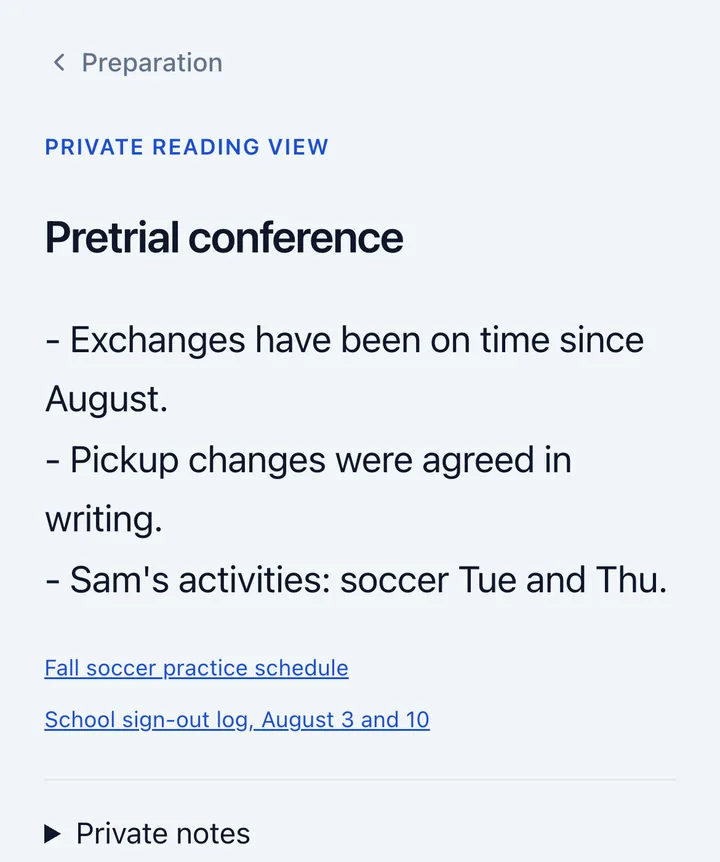
A hearing desk for each hearing, with your reading order and short notes in large text
Each note links to the exhibits it mentions
Private notes never go into court binder exports
Finish a desk to keep a snapshot, or carry it forward to the next hearing
5of 5
Bring in outside help whenever you want it
Presenting your own case doesn't mean you can't get help. Many courts run self-help centers that explain forms and procedures, legal aid offices help people who qualify for free, and some attorneys offer limited-scope help with a single task. For advice about your own case, talk to a licensed attorney where you live. You can share chosen parts of your file with anyone helping you.
General organizing tips, not legal advice. Your court's own rules come first.
Plans and pricing
Start free. Upgrade only if you need more.
The free plan needs no credit card and never expires. Hearing prep draws on your evidence, documents and timeline, so Full Suite covers all of it; for one hearing, the Hearing Pass is below.
Free
For getting your evidence out of your camera roll and into order.
$0
Free forever — no credit card, nothing to cancel.
One case file, unlimited court case numbers
10 evidence items, 1 GB of storage
Organize, describe, tag, search
Watermarked printable PDF export
6 AI actions to try the tools (one-time, not monthly)
Create your account, then after a short setup you can try Full Suite free for 7 days. Card required; then $24.99/mo or $299/yr (about 82¢ a day) until you cancel. Cancel before day 7 and you pay nothing. Or subscribe now — $299/yr
50% off · 20× the AI
Full Suite Max
Everything in Full Suite, with 20× the AI actions.
$99.99$49.99/mo
or $899/yr$399/yr
Everything in Full Suite: all five tools and the assistant
6,000 AI actions a month (20× Full Suite)
50% off (normally $99.99/mo), locked in as long as you don’t cancel
Already on Full Suite? Get 20× the AI credits for only +$25/mo more (prorated in place)
Clean, printable exports + free attorney & advocate access (on every plan)
$49.99 a month, renews until you cancel. Cancel online in two clicks.
Hearing Pass · one-time
$49 once for 30 days of hearing prep. Nothing renews.
Everything in Full Suite for 30 days from the day you buy it: all five tools, the assistant, AI included, and exports without a watermark. No subscription and nothing to cancel. When the 30 days end you’re back on the free plan, and nothing you added is deleted.
Your case stays private to your account until you invite someone and choose what they see. Data is encrypted in transit and at rest, and we don’t sell your personal information.
Your files stay yours
Originals are kept unchanged. Download your complete Case Bundle, every original file plus a manifest, free on any plan, before or after you cancel.
Cancel anytime, in two clicks
The free plan has nothing to cancel. Paid plans renew until you cancel online in two clicks, and the Hearing Pass never renews.
Organizing software, not a law firm
It organizes the files, dates and messages you provide. It doesn’t give legal advice, choose what you file or predict what a court will do.
Questions, answered straight
Frequently asked questions
Can I represent myself in family court?
Many family courts let parents represent themselves, often called appearing pro se or being self-represented. How it works depends on your court, so check its website or self-help center, or ask a licensed attorney where you live. Custody Commander doesn't decide that question for you; it helps you keep your own case organized either way.
What does Custody Commander do for a self-represented parent?
It keeps your case in one private file: a plan of preparation steps from the setup chat, evidence with each original kept unchanged, numbered exhibits, a dated timeline, documents, hearing reminders and private notes for the hearing. It also gathers links to your court's official rules, forms and self-help pages. You choose what to present; the app organizes and prints it.
Where can I find free help with my case?
Start with your court's self-help center or website, which often has forms and how-to guides. Your state's legal aid directory lists free programs for people who qualify, and law school clinics and bar referral services are other places to ask. Some attorneys also offer limited-scope help with one task or one hearing.
Does it fill out official court forms or file papers for me?
No. Custody Commander doesn't file anything with the court and doesn't provide official court forms. It has templates with [placeholders] that you complete and review, and your court's own forms and local rules come first. Nobody at Custody Commander reviews your documents.
Can I share my file if I work with an attorney later?
Yes. Invite an attorney by email and choose which sections they see, with view, comment, download or edit access for each. Attorneys join free, and you can revoke access at any time. You can also download an attorney handoff packet with your case summary, issues, timeline and evidence index in one PDF.
Is this legal advice?
No. Custody Commander is organizing software made by Firmbinder LLC, not a law firm, and nothing in it is legal advice. It never tells you what to argue, agree to or expect. For advice about your own case, talk to a licensed attorney where you live.
Is it free?
Yes. The free plan needs no card and never expires: one case, up to 10 evidence items, 1 GB of storage, 6 AI actions and exports watermarked DRAFT. Full Suite is $24.99 a month or $299 a year, and a one-time Hearing Pass ($49) covers 30 days of everything without renewing.
Present your own case from one organized file
Start free, answer the setup questions, and see what's still missing. Organizing software, not a law firm; not legal advice.